Showing posts with label NFL Today. Show all posts

Mega Mock Mania

3 Mock Drafts. Simultaneously Done. ESPN.com. Gotta Move It Quickly. Thank God For Dual Monitors.

Round 1

Looks like I'm picking 5, 5, and 8. That gives me some time to watch some more of the great thespian performed experience known as Malibu Most Wanted.

Joseph Addai (The safest of the tier 2 backs in my opinion), Joseph Addai (Peyton Manning assures good production from every player on the team), and Rudi Johnson (will only score 10 TD's when he could easily be given 15-18) (Addai went 3rd in my 8th pick league).

Round 2

Cedric Benson (After the top 15 picks I really don't like any of the next coming veteran backs), Cedric Benson (I still don't like him), Ronnie Brown (will have a very solid year due to better line-play, QB play, and Cam Cameron)

Already there are missing people in all the drafts.

Round 3

Thomas Jones (Until I know more about his injury I'm keeping him in this area, WR's are tempting though), Torry Holt (it was either him or Edgerrin James, I can wait on a 3rd back), Cedric Benson (Here, I'm more or a fan of his).

Round 4

Larry Fitzgerald (An insane talent that hopefully wont be held back by Ken Whisenhunt) ,Larry Fitzgerald (Leinart is going to throw 20-25 TD's and there aren't many people to catch them) ,Larry Fitzgerald (10 TD's is completely reasonable).

I love me some Pittsburgh WR.

Round 5

Adrian Peterson (I don't want him to be my 3rd back, or to take him the 5th round, but I have no choice), Adrian Peterson (here he is my 4th back and there are plenty of good #2 recievers left so I'm much happier), TJ Houshmandzadeh (you know he's going to get about 80 yards a game as the possession reciever)

Round 6

Andre Johnson (always gets lots of receptions and have a good pre-season QB), Andre Johnson (Shaub did manage to get 300 yards against New England once during one of their bad D spells) ,I lost this draft and can't get it back. Marshawn Lynch was the pick.

Round 7

Tony Romo (someone has to throw TO his TD's), Phillip Rivers (I went for him over Romo, they should be about the same even though the Chargers will score more points.

Round 8

Jon Kitna (year 2 with Air Martz is going to be better, not great, better), Tony Romo (got him anyway)

Round 9

Matt Leinart (I don't like having the WR and QB, but hes good and 3rd string), Eli Manning (I hate him so much, but he's the best pick here with Leinart gone)

Round 10

Jay Cutler (why not?), Vincent Jackson (the #1 receiver in a good offense, and he's improving)

Round 11

Santonio Holmes (that's a heck of a 4th WR with who my first 3 are), Santonio Holmes (a very solid #4 wide receiver)

Round 12

Jason Witten (a good solid TE who has better upside than my stand-by Dallas Clark who has to split a bigger pie so many ways), Jason Witten (the guy should have never dropped to the 3rd round coming out of Tennessee)

Round 13

Brandon Marshall (a good potential steal who Jay Culter loves throwing too, the #2 reciever in Denver now), Brandon Marshall (his physical skills are off the charts)

Round 14

Chargers Defense (that's great in Round 14 with the players and scheme they have), Broncos Defense (Champ Bailey and Dre Bly, that's deadly)

Round 15

Broncos Defense (This defense is going to be good, I always hope there still here), Cowboys Defense (with Wade Phillips around their sack numbers should go up along with their picks)

Round 16

John Kasey (he's good at 50+ and who really cares anyway), John Kasey (give me any kicker really, i spend about 30 seconds a week worrying about them)

So after one draft crashes this is how the two remaining teams looks.

Team 1

QB: Tony Romo, Jon Kitna, Matt Leinart, Jay Cutler
RB: Joseph Addai, Cedric Benson, Adrian Peterson
WR: Torry Holt, Larry Fitzgerald, Santonio Holmes, Brandon Marshall
TE: Jason Witten
DEF: Chargers, Broncos
K: Jason Kasey

Not enough backs, but there was no one left worth taking. Hello waiver wire.

Team 2

QB: Phillip Rivers, Tony Romo, Eli Manning
RB: Joseph Addai, Cedric Benson, Thomas Jones, Adrian Peterson
WR: Larry Fitzgerald, Andre Johnson, Vincent Jackson, Santonio Holmes, Brandon Marshall
TE: Jason Witten
DEF: Broncos, Cowboys
K: John Kasey

I'm still not happy with my backs on this team.

So what do i get for this? I completed 2/3 so that's a solid D. That's we in the biz call a passing grade. So until next time, enjoy not wasting your time reading this.

Just remember, don't take fantasy football too seriously because...

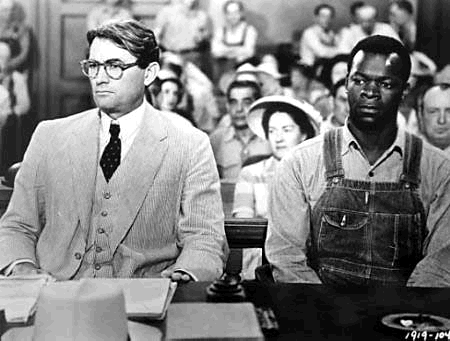
To Kill A Mocking Draft

The one place where a man ought to get a square deal is in a courtroom, be he any color of the rainbow, but people have a way of carrying their resentments right into a jury box. As you grow older, you'll see white men cheat black men every day of your life, but let me tell you something and don't you forget it - whenever a white man does that to a black man, no matter who he is, how rich he is, or how fine a family he comes from, that white man is trash. ~Harper Lee, To Kill a Mockingbird, Chapter 23, spoken by the character Atticus

Early in the history of fantasy football racism was wide spread. Weird rules such as, "the white man always get Jim Brown," were constantly ruining the game. Today, racial harmony abounds after the efforts of Atticus Finch in the famous "Scopes LT2 Trial". To celebrate the harmony, it's time for another Mock Mock Draft. Let's get moving.

The waiver wire was not always so clean and simple...

Round 1:

This could actually end up being Mock Draft 1 Directors Cut. I've got the top pick again. And it's LT2 of course. Choosing LT2 is like Halle Barry. Just do it.

#2 Steven Jackson
#3 Larry Johnson
#4 Frank Gore
#5 Joseph Addai
#6 Shaun Alexander
#7 Brain Westbrook
#8 Willie Parker
#9 Peyton Manning (always somebody...)
#10 Willis McGahee (huh?)

Not a single auto-pick in round 1. A true Christmas miracle.

Round 2:

I can only hope a good back falls to me at #20 overall. Commence praying. The Greek God of Fantasy Football Drafts is Pluto. Not alot to do but play FF in Hades.

1 pick from getting Ronnie Brown. Gotta take Cedric Benson again.

Round 3:

Thomas Jones. So far I'm 3/3 copying last time. I keep getting the feeling that I should be picking a top WR there though. I just see too many other true #3 or possibly #2 backs sitting down below Thomas Jones.

Round 4:

I'm hoping for Houshmandzadeh and Boldin in 4 and 5. And yes, I know how to spell Houshmandzadeh from my head.

I can't believe how highly Marques Colston is rated. I would never take him in front of the guys I'm hoping for. People taking him in Round 4 I believe are going to be disappointed. Not very, just some disappointment.

Roy Williams. I didn't think he would still be around when I was praying to Pluto.

Round 5:

Anquan Boldin, everyone's favorite 5.6 40 WR.

Round 6:

Come on Adrain Peterson. I need Adrian Peterson like a fat kid needs a well balanced diet and exercise program.

Already gone. Someone jumped 10 spots down in the rankings and took him.

Hines Ward. I took him over Santana Moss because he is more consistent which is what I want out of a bye week back-up with some elite receivers starting. Maybe Santana Moss would have been better though...

Round 7:

Jamal Lewis. I just couldn't take Ladell Betts. I just see him and Portis sucking it up splitting carries all year as neither gets hurt. I just know Jamal is going to suck it as the starter for the browns probably anyway though. It's all hope at this point. It's a fourth back though. How good does he have to be?

Still no computer pickers. This is amazing.

Round 8:

Ward has averaged 8.6 TD's the last 5 years and is only 31. Plus Roethlisberger will likely play better this year than last which will help Ward catch more than the 6 he caught last year (11 in 05). I feel good about that now.

I'm two picks from getting Laddell Betts. Praise be to Pluto.

Nevermind. He went. Back to plan B. Leinert and Culter. QB's have been going earlier than before so no Romo and Rivers.

Boom! Matt Leinert.

Round 9:

Boom! Jay Cutler. That's a good 1-2 Platoon.

2 Auto-pickers now. Still pretty good if 80% are still present.

Round 10:

Bernard Berrian. I'm just lukewarm on everyone else.

Round 11:

Michael Turner. Handcuff pick. I don't know why I did that though. I don't even really believe in handcuff picks.

I'm drafting like a dumbass right now.

Round 12:

I can't decide between Santonio Holmes and Calvin Johnson. It's my 5th WR so I think its time for a risk with the man who surely is using some of his signing bonus to kill Reggie Ball.

3 Auto-pickers. Still not bad.

They stole Calvin Johnson. I will never forgive that. I had to take Jason Campbell, who I believe will play well this year, here.

Round 13:

Jason Witten. Best TE I've gotten in these Mock Mock Drafts so far.

Round 14:

Denver Broncos D. Gonna be good.

Round 15:

Dallas Cowboys D. Gonna be good.

Round 16:

John Kasey. The good old long bomber.

That's it. I'm 100% done mocking this draft up. After seeing my skills in action your welcome to hire me for your draft for the low price of $250 an hour. Just call 1-800-DRAFT-ME. Guaranteed to be almost as good as throwing your money into a fiery pit.

Mocking My Mock Mock Draft

Mock Fantasy Football drafts are great for learning. You see where players will likely be picked, get a chance to study team's rosters, and begin to get a feeling for how you want to play your real draft by drafting from numerous different draft positions. Unfortunately, they also have a tendency to make you miserable. Consider this scenario from earlier this week. I do a mock draft and besides some pretty good backs (Joseph Addai, Ronnie Brown), my receiver corps were the greatest I would have had in my 7 year fantasy career. We're talking...

Terrell Owens

Roy Williams

T.J. Houshmandzadeh

with Kevin Curtis backing them up for bye weeks. I would kill to actually have this in addition to my crazy QB rotation (Phillip Rivers, Matt Leinert, and Tony Romo). Unfortunately it was all just make believe.

So to avoid that great heart break, I've decided today to attempt to distance myself from the preceding further than before. I'm doing a mock mock draft. It's a not a real mock draft. I'm just seeing how normal mock drafts are going. That way when I mock draft I'll be better prepared to deal with my mock draft which will help me prepare for my real draft. Let's get to it thanks to ESPN.com easy mock draft system (really its nice and easy, there not paying me).

Round 1:

I received the first pick in the draft and selected T.J. Duckett. I see a bright future for him in whatever place he's currently playing 3rd string. I can see him being a back-up by Week 10. Or maybe I did the obvious and took LT. You'll never know...

From that point on it goes Steven Jackson, Larry Johnson, Frank Gore, Shaun Alexander. After the top 2 picks its really all the same to me with Larry Johnson maybe slightly better. I just don't like people who holdout, play with bad QB's, carry the ball 400+ times, and act like their gangsters when there from Happy Valley, Pennsylvania.

I'm just hoping Travis Henry somehow drops to me at the the 20th overall pick which he might because somebody who really doesn't understand fantasy football always takes Manning in round 1 and some other fool always hops at the chance for Brady in Round 2. Its running back-running back 98% of the time. It has to be if you want the best chance to win your league. This is not an arguable point.

Round 2:

Did I say espn.com was great for this. Well it is when people actually show up. It's ridiculous with mock drafts every five minutes and easy to get into that people would ever miss round 1. If people miss more than 1 or 2 of these past round 7 or 8 they should be banned.

Travis Henry. 2nd ranked back left. 5 picks to go.

No Henry. I took Cedric Benson. At least he's unquestioned starter on a decent team.

Round 3:

Deuce McAllister. I probably should have taken a WR, but if on the way back I can get Adrian Peterson I'm going to be stacked. I really don't know what I was thinking though. Chad Johnson was mine. With LT I can deal with a bad 3rd back. (The pick was suppose to Thomas Jones, but it glitched and crashed and autopicked for me)

It's moving fast because there are so many autopicks now.

Round 4/5:

I just outdid myself. I got T.O. and Larry Fitzgerald. I'm so happy. This Mock Mock Mock Mock draft is going to so well. I can't wait to Mock Mock Mock Draft for real.

Round 6/7:

Adrian Peterson and a now very undervalued Santana Moss. He could have a big bounce back year. A healthy Peterson is also a major stud (Yes, I would use him to bred me new running backs so the term is correct).

Round 8/9:

YEAH! One actually person left drafting. Me. I guess my skills just ran everyone else off. This should go real fast.

Romo and Kitna at QB. I just keep getting this nagging feeling that Mike Martz is unstoppable. He has his old stand by (Roy Williams) , his rookie (Calvin Johnson), and his random veteran QB (Jon Kitna). He's just missing a Marshall Faulk, but Kitna can still throw for alot of yards if not as many TD's with the parts he has.

Round 10/11:

Still got Leinert and added Tatum Bell. Moving so fast.

Round 12/13:

Dallas Clark (always a good top 10 TE) and Jay Cutler. I can't turn down a good QB. I now have 4. Screw D and Kickers.

Round 14/15:

Broncos D (they'll be really good, trust me) and the Cowboys D (they'll be really good, trust me)

Round 16:

And my kicker. Good old long bomber John Kasey.

And were done. My heart is not aching over losing this awesome team. I feel good. Time to move up a level. I gotta get Mock Mock Mock Mock Mock Mock Mock drafting in a hurry so I can work up to my real draft. So until next time, this was a waste of your time.

Predicting the NFL: Part #2

Yesterday, we examined a means to determine of many games a team will win in a given season. We found that by using the Pythagorean Method or a team's point differential we could tell a team's record with an accuracy of about plus or minus one win. Both of those methods simply required finding how many points a team scored in a given season and how many points they gave, then performing a quick calculation with that information. Today, we are going to look a little deeper into the numbers that were found in the process of developing yesterday's article and see if we can find any other interesting nuggets from them. So without further, ado, lets get moving with a top 10 fact find:

1. Over the course of the last 10 years, 5 teams (04 New England Patriots, 02 Tampa Bay Buccaneers, 99 St. Louis Rams, 98 Denver Broncos, 97 Denver Broncos) have the Super Bowl during the year where the posted the highest point differential in the league. This means that by the recent past data on the NFL, simply picking the team with the largest point differential to win the Super Bowl next year should give you a 50/50 chance at being correct.

2. The only team to average over 400 points scored over the last 10 seasons is the Indianapolis Colts making them the best offensive by that measure over the last decade. There average score of 407.2 points per season was substantially higher than their next closest competitor, the St. Louis Rams, who came in with an average of 396.5 points per season.

3. There were 3 teams over the course of the last 10 years who were able on average to give up less than 300 points for a season: the Miami Dolphins (296) , the Baltimore Ravens (279), and the Tampa Bay Buccaneers (273.3). Tampa Bay, despite having only one winning season in the last four still played well enough on defense to be the best overall of the decade by this measure.

4. Only two teams in the last 10 years have won the Super Bowl while leading the league in scoring: the 97 Denver Broncos and the 99 St. Louis Rams. Both of these teams also played excellent defense as shown by the fact they both surrendered under 290 points for their championship season.

5. Only three teams in the last 10 years have won the Super Bowl while leading the league in defensive points allowed: the 00 Baltimore Ravens, the 02 Tampa Bay Buccaneers 03, and the New England Patriots. None of these teams had a top five offense in the season they won their championship, and none of them scored over 350 points during the season on offense.

6. During the course of the last 10 years, there has overall never been a large shift in the number of points scored total by the league. While there have been a few anomaly years (in 02 and 04 scoring suddenly jumped into the 340 range per team), the total average amount of points scored per team has hung around 330 points per season over the course of the last 10 years.

7. If you take the equation used in part #1 of this series, a team should win 0 games in a season if they can manage to be outscored for the year by 285 points or approximately 18 points per game. On the other hand, a team should be win their complete schedule if they can outscore their competition for the year by 285 points or approximately 18 points per game. To be that bad would require something worse than the NFL has ever seen as no one has approached being that horrible in the last 10 years. To be that good would make a team the 99 St. Louis Rams, who won 13 games despite have a point differential of 284 points for the season (no one else came close to them in that respect).

8. The team which managed to post the worst average point differential over the last 10 years was the Arizona Cardinals at -113.8 points per season. The only competitors for their crown at over 100 points less than their opponents were the two expansion teams that did not play the whole decade (Cleveland Browns, Houston Texans). The team with the best point differential over the last team years is the Denver Broncos at an average of 84.6 point per season. There next closest competitor is barely even close with the New England Patriots finishing at 65.1 points per season.

9. When associating offense with the number of wins a team has per season there is a resulting R^2 value of .5448. When association defense with the number of wins a team has per season there is a resulting R^2 value of .489. This means that according to the last 10 years of data, there is more of an association between winning game and offense than there is winning games and defense; however, neither of the associations are very large meaning that neither offense nor defense alone is an effective predictor of team success.

10. Going by the equations generated when comparing offense to wins, a team would need to score 579 points (36.2 per game) in order to win 16 games in a season. To lose 16 games it would need to score only 89 points (5.6 per game) for the year. Going by the defensive equation, a team would need to give up only 116 points (7.2 per game) in order to go undefeated. To lose every single game they would need to surrender 552 points per game. None of those values calculated high or low have been reached in the last 10 years.

So there we have it, ten interesting tidbits we can pull out of the big hunk of data that was gathered. There are many more which can be found, but those will have to be saved for another time (If I do them all now, I'll be out of a job and quiet tired). If any reader has an interesting fact related to this type of subject feel free to e-mail me at tmx117@gmail.com and if its up to par I can report it here and give you all the beautiful credit. Until then, remember when your doing synthetic division to place in zero values when the exponents are not decreasing in order by one (Yes! I managed to make my "I'm out" statement more obscure).

A cryptic preview of Monday's likely article

Predicting the NFL: Part #1

Over the course of the last couple weeks, I have been collecting data concerning the last 10 years of the NBA in order to find a good means of predicting a team's win total for a season. With much of that laid to rest, I began to wonder how the things that were discovered in the NBA would work when applied to another professional sports league, the NFL.

My goal with this study is to determine a method for accurately predicting a teams win and loss record for a season based on simple statistics that can be pulled from any sport's reference site. In order to limit the scope of the study, I choose to take the two methods that I found most effective in the NBA and apply them as best as I could to the NFL using the last 10 years results for every team as my sample. The two methods that will be used as predictors to be tested are the Pythagorean method and the point differential equation method.

The first method we will be using, the Pythagorean Method, is based on a time tested equation developed by many of the forefathers of sport's statistical analysis. What is basically states is that a team's win percentage will be about equal to

(Points Scored)^X/((Points Scored)^X+(Points Surrendered)^X)

where X is a variable that changes depending on what sport is being tested. In order to get the best results possible and since there is not a current accepted number for professional football that has undergone rigorous testing, we will determine X ourselves during the study by allowing it to be the number which gives the best overall result. During the NBA study, this method proved slightly less accurate but slightly more precise then our next method of testing.

The point differential equation method is developed by taking all the point differentials for all of the teams over the last 10 years and graphing them against the number of wins each of the given teams had. Once that is down a linear relationship will be found inside the data as best as possible, and the resulting linear equation will be used to predict, based on the data, how many wins a team should have for a given point differential. We will find this equation ourselves during the course of the study and then use it to test our data. Using this method in the NBA study, the results were slightly more accurate but slightly less precise. Overall, neither of the methods was found to be significantly better than the other in any real way.

With all or points and win totals in the spreadsheet, the first step that was taken was to create the graph which would provide for us the linear relation we will use for the point differential method. The graph turned out as below:

Our resulting linearization of the data produced an equation that stated Wins=.0281(Point Differential)+8.005 with an R^2 value of .8435 (the NBA's was about .93 so the NFL's is slightly less of a good fit, but it is still a decent fit). With this equation in the hand, we can now predict how many games each team over the last 10 years should have won based on their point differential.

Using the point differential equation, over the last 10 years the average prediction for a team's win total was off by .976 wins. Basically this means that normally an 8-8 team would be predicted in the range of 7-9 to 9-7 which is very good for simply using one number to predict the entirety of team success. Even one blowout of demolishing of a team could skew the numbers up or down so it is very difficult to expect more than we received from this data test. Precision wise, the entirety of the data came out with a standard deviation of .827 wins which means that is was very precise data. With these numbers in mind, we must view the Pythagorean results to see if these are the cream of the crop or if it is just a less substitute when a better method is not available.

With all of the data in the spreadsheet and it set to create the complete average of all of the results, I began to adjust the exponent until I got the best results possible. After all the adjusting was done the best exponent came out to be 2.6, which resulted in an average win difference of .965 wins per team, which is just slightly better than our result using the other method. Its standard deviation was also better than that of the other method as it came in at .708 wins which was about .1 wins better than the point differential method, so it is more precise than the other method. With all of this data in mind, does the fact that the results came in this way really mean that the Pythagorean Method is superior the point differential method?

In my opinion based on seeing the data and the difficulty of doing the work to find each of the results, I would give a very qualified yes. Pythagorean came out to be the more accurate and precise method over the last 10 years even when the data is divided into the first and last 5 years of the study. The point differential was the best measure in only 4 of the 10 years and always by extremely thin margins (in 1 measure they were better by one one thousandth), whereas many times the Pythagorean method was better by up to .3 wins. In simple data measurement, though, point differential cannot necessarily be statistically shown to be an actually worse method within margin of error, but the last little bit that pushed it into the yes territory is the work required to find it. Finding the exponent takes all of 1 or 2 minutes if you have set your spreadsheet up correctly and once that is found it is easy to test more future and past numbers in it. The point differential method requires some additional spreadsheet set-up and requires graphing, which simply takes up more time as well. In addition, the Pythagorean method is simpler to remember as the non-exponent part and one number, the exponent, that must be memorized are both very simple. On the other hand, the linear equation while not hard to remember in its form involves two longer decimals to remember. Its not a huge deal, but if you are quickly trying to get calculations done, Pythagorean is quicker and according to what we have unsignificantly proven, more accurate.

In conclusion, what the data does conclusively show is that both of these methods are extremely effective at taking a singular statistical measure (or two, depending on how you read it/counted it) and predicting how a team's season will turn out. There may be ways to adjust these numbers to come up with a statistically better method of predicting their win total, but I have not happened upon it yet as I have worked. If anyone reader has found a better method and would like to talk about it here/tell me about it and let me talk about it, drop me a line at tmx117@gmail.com and tell me all about it. Tomorrow, I will delve deeper into the current numbers to come up with a list of numerous observations that can be made from it, but until then, don't forget to carry the one (HAHA! not funny at all).

(Note: If you have an interest in playing with the numbers I used for this study, the exact spreadsheet I used is available here.)

Fantasy Football Wisdom Tested

If I had unlimited time and resources on my hands I am certain there is one thing I would spend a large chunk of infinite (OK, you can't really have a large chuck of infinite b/c anything/infinite=effectively 0) figuring some sort of computer model that would tell a fantasy football drafter what player to select when their chance came up based on all past evidence. I recall attempting to do this once for a few hours with another math loving buddy of mine, and after my mind was completely boggled I gave up and watched TV. That does not mean of course that we can't test some of the commonly held logic used in fantasy football drafts mathematically.

The #1 general rule in any fantasy football draft is that running backs are the most important thing that you must draft. Most drafts will feature an entire first round of running back selections (with the exception of an occasional QB or WR), and nobody every really questions that if it is the smart thing to do. Everyone can give you a reason as to why they do it (hard to find good RB's late, there consistent players, b/c since everyone else is doing it I have no choice), but are there any strong mathematical reasons behind the thought process. Lets look at the numbers:

QB Points Total Standard Deviation
Peyton Manning 358 10.35
Drew Brees 302 11.69
Michael Vick 286 10.80
Marc Bulger 284 11.62
Carson Palmer 282 9.63
Tom Brady 250 8.63
Phillip Rivers 240 8.64
Jon Kitna 236 9.77
Eli Manning 226 8.54
Donovan McNabb 216 11.11
Vince Young 212 9.73
Brett Favre 212 10.34
Average 258.66 10.07
Average-PM 249.63
Top-Bottom 146
2nd Top-Bottom 90
StanD 44.57
StanD-PM 33.30

RB Points Total Standard Deviation
LaDainian Tomlinson 420 12.80
Larry Johnson 318 10.07
Steven Jackson 316 10.01
Frank Gore 250 8.03
Willie Parker 246 10.68
Brian Westbrook 238 9.29
Tiki Barber 220 9.82
Maurice Jones-Drew 200 8.75
Rudi Johnson 196 6.54
Deuce McAllister 176 6.21
Marion Barber 176 7.42
Joseph Addai 172 9.92
Average 244 9.13
Average-LT 228
Top-Bottom 248
2nd Top-Bottom 146
StanD 74.44
StanD-LT 52.12

WR PointsTotal Standard Deviation
Marvin Harrison 198 8.80
Terrell Owens 192 5.89
Reggie Wayne 184 7.52
Lee Evans 176 9.47
Donald Driver 176 6.66
Torry Holt 170 8.11
Chad Johnson 181 10.79
T.J. Houshmandzadeh 171 6.55
Javon Walker 170 9.28
Steve Smith 166 7.86
Roy Williams 166 7.16
Plaxico Burress 152 5.89
Average 175.16 7.83
StanD 12.40
Top-Bottom 46


To gather my data I relied on what was readily available to me, the NFL.com scoring point system and results. For those not familiar with the NFL.com scoring system, it rewards 1 point per 10 rushing/receiving yards, 1 point per 25 passing yards, and 6 points for touchdowns. It deducts for fumbles and interceptions. It is a rather standard league, but if you would like the full details they are available here. In the above charts I took the top 12 players (12 is the number of teams in an NFL.com draft) at QB, WR, and RB according to NFL.com from last year, gave their total points, the standard deviation of their weekly points, and other break downs on their numbers. So what do all those above numbers tell us?

First of all, from the data above we can see that QB's in the Top 12 score slighly more points than the RB's even if we allow the RB's to keep LaDanian Tomlinson and we remove Peyton Manning from the QB's. It is not a big margin though. What is quite clear though is that WR's score much less on average than the other two possible first round position possibilities. That is one strike against taking them in the first round. Does the fact that the QB's score slightly more than the RB's mean we are wrong to put our focus on the halfbacks so early in the draft? The others numbers suggest the exact opposite.

The RB's came in as slightly more consistant than the Quarterbacks when a standard deviation was taken for their week-by-week totals was taken. A QB supporter could chalk this up to the fact that the QB's score more points so they naturally have a wider possible range, which could be a valid point, but there is much more evidence still left to consider. The standard deviations amongst the top 12 at each position even when taking out top players from each side or allowing one side to keep their top player are massively different. With LT factored in the standard deviation of the RB scores is 30 points higher than that of the QB's, and even with him out the RB's still remain 8 points higher with the QB's allow to keep Peyton Manning (there top performer). What this means is that each of the quarterbacks is much closer to an average score for their positions than are the RB's. Every single RB picked before you will result in more points lose of the course of a season than will each QB picked. Even more evidence comes to support this when you look at the #1 or #2 QB or RB vs. the #12 QB or RB. The difference between Manning and the 12th QB is only 146 points compared to 248 points for the RB's (LT to #12). Even if you throw out LT's amazing year (you can't plan a draft around getting LT) the RB's still match the QB's (w/o Manning the QB's would be back behind 50 points again).

So, the idea that running backs are more consistent than QB's proved true last year (I cannot conclusively say this is always true based on the data I've collected so far) and the drop off from RB to RB is largest than that among QB's so getting the 12th back is much bigger lose than getting the 12th QB. With those facts in the book though, should a WR, who we already know score lower than these other two substantially, even be considered? According to our data, the answer is a definite no. WR's week-by-week come in as more consistent than RB's and QB's by standard deviation (7.83), but once again this could be due to the fact since they score less their possibility of score ranges is smaller.; however, the drop off from the #1 to the #12 WR or anything inside of that range is simply not a very big deal compared to the other positions discussed. Their total score standard deviation was pitifully small compared to RB's and QB's (12.40) and their top minus bottom was only 46 points meaning that there is not a big comparative drop-off among the top 12 wide receivers like there is at the other positions. Unless you've got a time machine and know a WR is catching 20 TD's to go along with 1500 yards in the next season it just would never make sense to think of taking a WR extremely early in the draft (1st round is out of the question).

This study is by no means comprehensive and even on this year's data there are many more observations that could be taken on it. It does seem from what our current data situation tells us though that the "RB, early and often" strategy is a mathematically sound means of determining who a person should draft. It would be wonderful if anyone reading this would like to pick up the ball and run with this idea to test is further as I would like to. In the coming weeks I'm going to try to at least gather more data and put it on the site even if I do not grow each post into a full length article. There is so much luck in fantasy football that any reason based edge a player can gain is huge boost to their cause (especially when money is involved), so I feel this information is truly valuable. For now though, if you want to become the uber-nerd of your fantasy football draft party, when someone selects Terrell Owens in the first round of your local draft, whip the good old spreadsheet out and explain to them just why they are going to finish in last place this season.

Blog Archive